


Connect With Us
Visit Us
250 West Nyack Road, Suite #200 West Nyack, NY 10994
Get Directions
Call Us Toll Free
877-GO-RUSTY
877-467-8789
Telephone
845-369-6869
Fax
845-228-8177
Departments
Departments
Departments
SUBSCRIBE TO NEWSCONTACT US
Last Updated: 11/04/2004
I write this as I fly back to New York from the Search Engine Strategies Conference in Stockholm, Sweden of 2004. Scandinavian is one of those emerging search engine optimization markets, with much growth over the past six months and enormous anticipated future growth. But yet, at this time, many are new to the SEO game. Web links is an area where there is often confusion and anxiety for novices. Therefore, this article will discuss how search engines interpret Web links, as opposed to how a Web user might interpret Web links. The information below is my personal understanding of the true meaning of links from the search engine's perspective. As many of you know, only the search engine engineers themselves truly hold the answer to these questions. However, for purposes of this article, I will be conveying this information in a fairly simplistic manner, by staying away from the algorithmic definitions and taking a painless and layman approach.
By the end of this short article you should be able to understand:
Basics Web Link Definition
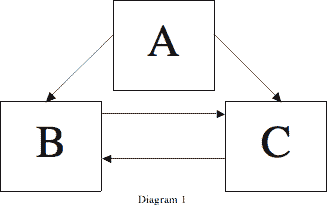 When explaining link building to clients, prospects and those interested in listening, I often need to draw a diagram. Diagram 1 portrays three pages A, B and C. Page A links to page B and page A links to page C, however, page C does not link to page A nor does page B link to page A. In addition, you will notice that page B links to page C and page C links to page B.
SEO Link Terms
A term that you will often hear in the SEO community is a "reciprocal link". A reciprocal link is an exchange of a link between two pages. In diagram 1, pages B and C would be considered a reciprocal link (note: keeping it simple here). A one-way link is another SEO phrase you will hear. A one-way link is when a page links to another page without a link back from the same page. In diagram 1, a one-way link would be considered the link from page A to page B and the link from Page A to page C.
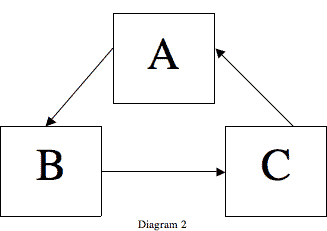 In Diagram 2, you will see a slightly different link structure between the three pages. Page A links to page B and page B links to page C, as like before in diagram 1. However, Page A does not link to page C, nor does page C link to page B. Instead we have a non-reciprocated link (or one-way link) from page B links to page C and a one-way link from page C to page A.
You should by now notice the triangular fashion in which page A links to page B and page B links page C and page C links to page A. This type of linking is coined, "triangular linking."
Search Engine's View of Web Links
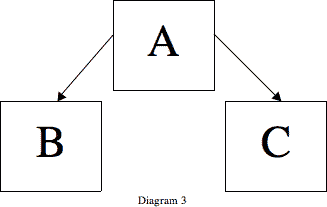 Before conceptualizing how a search engine views a link, I want to define one more term, used often within the search engine company. In diagram 3, you will notice that Page B and page C are connected through page A. In other words, there is a "direct edge" between B and C, which is A.
Search engines can view page B and C to be within the same community, or at least assign a lower weight then a direct link between the two pages of the community-like relationship between page B and C.
Link Structure of the Web
Search engines can take a step beyond what humans can compute. They look at the entire Web from a one-way linkage view, triangular linkage view, reciprocal linkage view and a direct edge linkage view.
Envision the three diagrams multiplied together to form hundreds, if not, thousands of pages with some sorts of linkage between the two. Now isolate the pages that link in one of the four fashions mentioned above and assign a solid red line to represent a one-way link, a dotted red link to represent a reciprocal link, then mentally note the links that are triangular in nature and finally, I have highlighted the links that are direct edges in yellow/red. After you have all of that mapped out, stand over this color document and look down. You should be able to quickly see an unnatural linking pattern between groups of pages. For example, look at the page on the second row to the left, second box down. You will see that many dotted red lines point to the box (page). That means there is a lot of reciprocal linking taking place between that page and others. While you are at it, try to locate pages that are linking in triangular patterns versus one way links.
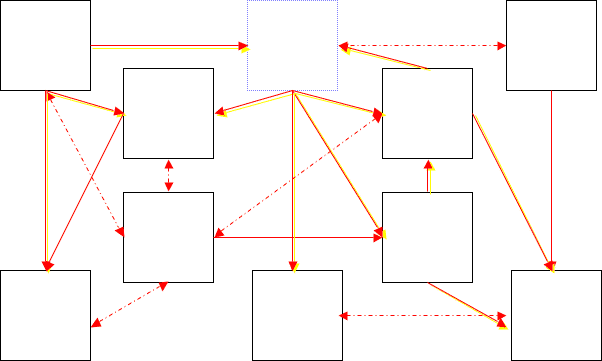
Search engines have the computational power, the algorithmic know-how and the experience to effortlessly find any unnatural linkage scheme. Of course, you need to determine what would be unnatural versus natural. It is very possible for you to naturally have reciprocal links, triangular links and so on. But if you see an 'excessive' pattern of one category of the link types mentioned above, then a red flag may be raised.
ConclusionWhen working on your link building campaign, it helps to have rich and unique content, free tools, a good brand or a real reason for other pages to link to your pages. The best types of links are those that are not asked for, people linking to your pages because they are truly helpful to the referrer's Web visitor. Buying links, conducting link exchanges, and performing any linkage schemes that feels unethical, is most probably unnatural. Unnatural linkage schemes are a problem for many of the search engines today. As time goes on, you can bet that the search engines will determine quick methods to reduce the weight of 'unnatural' types of links. So it is best to act now and build the most authoritative and informative site for your niche, in order to get the most natural and positive link citations.
RustyBrick SEO Articles
For more information on our search engine optimization and search engine placement services, please contact us at 877-GO-RUSTY or 845-369-6869 or via email at our contact page.

Barry Schwartz is the CEO of RustyBrick, a New York Web service firm specializing in customized online technology that helps companies decrease costs and increase sales. Barry is also the founder of the Search Engine Roundtable and the News Editor of Search Engine Land. He is well known & respected for his expertise in the search marketing industry. Barry graduated from the City University of New York and lives with his family in the NYC region.
This article is under Search Engine Optimization
There is 1 comment for this post
250 West Nyack Road, Suite #200 West Nyack, NY 10994
Get Directions
877-GO-RUSTY
877-467-8789
845-369-6869
845-228-8177
1 OLDER COMMENT
posted by WebGuy84 on: Oct 18, 2006 11:06am
Yeah good choice. I would like to say thanks to Shawn for his great site, especially the forums which are very useful. Thx Shawn
1 COMMENT